

Solitary Bee Hotel Study
When we think of bees, we think of either honeybees or bumblebees, but there many other species of bees. In this country, there is only one species of honeybee, 24 different bumblebee species and over 200 species of solitary bees. Wild honeybees and bumblebees build nests and form colonies working together to gather pollen. We also assume that honeybees are the main pollinators of plants, but these insects are not very efficient at gathering pollen in corbiculae (pollen baskets) on their hind legs. Bumblebees and solitary bees actually pollenate more plants often by carrying pollen on their bodies and hairs on the abdomen.
Solitary bees are a large group including different species: mason, mining, leaf-cutter, carder and even parasitic bees that prey on other bees. These bees nest in small holes in wood, walls, plants or underground. They lay their eggs surrounded by pollen and then seal the hole with saliva, mud or leaf depending on the species laying the eggs. It is the bee house or bee hotel for solitary bees that is often bought by gardeners to increase pollination of their plants. These structures are normally made of hollow tubes made from wood, cardboard or bamboo. We have a number of different bee houses and tubes in the orchard to help with pollination. This study we set up was to determine which is the best diameter hole to use, which species uses which hole and when do they start laying eggs or pupate from the nest. The initial study started two years ago used wooden blocks drilled with either 4, 5, 6, 7, 8 or 10mm holes. The 8 and 10mm holes were too large and were seldom used so this years study was confined to the 4 to 7mm sized holes. The study involved existing blocks with many of the holes already filled at the start of the study.


Wooden posts were cut to 6inches in length and drilled with 4 or 5mm holes or 6 and 7mm holes. Filled holes with pollen and eggs are closed and empty holes open.
We followed the above blocks and another two original blocks with a total of 40 holes for each of the different sized holes. The results are shown as percentage of holes filled for each of the months that have been recorded.

The bees that fill the 4 and 5mm holes emerge from the holes in early summer and then lay their eggs in September and October. The bees in the 6 and 7mm emerge earlier in the year in Spring and have not laid eggs by October. Precise dates and activity will be studied in 2026 by placing new, empty, houses in the hotel, we cannot empty the existing holes in the houses as there may be bee pupae still in them.
We did photograph bees going into and out of some of the hole. The smaller (4 and 5mm) holes were entered by small black bees from the scissor bee order, not sure which particular bee as different species in the order.

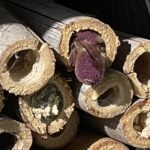
The larger holes were visited by larger brown bees, in the picture shown the bee is covered in purple pollen. Again it is difficult to be precise as to the identification of the particular bee but they are probably mason bees.

Further studies will be undertaken next year, we did join a nationwide study of bee hotels (Buzz Club) and the results will be published by the end of the year.